Table of Contents
Earth is a unique planet of the universe because life is found only on this planet. For the exitance of life on the earth the air has played an important role. The air make conditions which is necessary for life. The air is the mixture of several gases found in the atmosphere. The air or the mixture of several gases compasses the earth from all sides and creates atmosphere. The atmosphere is an integral part of the planet called Earth. The gravitational force of the earth played an important role to connect atmosphere with the earth surface.
The atmosphere helps the following activities –
– Help to stop the ultra violet rays which is harmful for the life.
– Help to maintain the suitable temperature which is also necessary for life.
For more details you can read the these articles by clicking on the following links.
Atmosphere of Earth – A Blanket of Gases
Layers of Earth’s Atmosphere | World Geography | UPSC | SSC
The atmosphere of the earth is made up of different types of gases, water vapour and dust particles. The composition of the atmosphere is not static. It may be different according to the time and place.
Composition of Earth’s Atmosphere
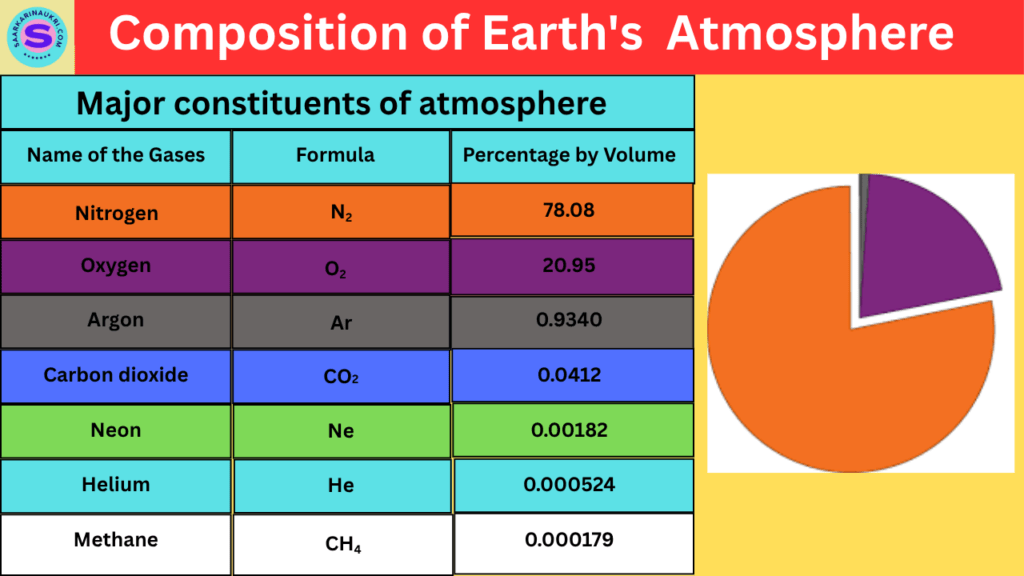
The Earth’s atmosphere is the composition of main four elements and they are –
01) Main Gases
02) Secondary Gases
03) Water Vapour
04) Dust Particles
Main Gases
Nitrogen –
The account of Nitrogen gas is 78% of total atmospheric volume.
Nitrogen gas is a relatively inert gas in the earth’s atmosphere but is an important constituent of all organic compounds.
The main function of Nitrogen gas is to control combustion of Oxygen gas by diluting.
The Nitrogen gas indirectly helps in oxidation of different kinds.
Oxygen –
Oxygen gas is an important for the survival of the life on the earth.
The Oxygen gas constitutes only 21% of total volume of atmosphere.
Oxygen gas is the most important component among all found gases for all the living organisms.
Oxygen gas is the only gas which can inhale by all the living organisms to live.
Oxygen gas can combine with other elements to form important compounds such as oxides.
The combustion is not possible without the gas Oxygen.
Carbon Dioxide –
The third important gas is Carbon Dioxide.
The Carbon Dioxide constitutes at about 03% of the atmosphere and is a product of combustion.
The plants and trees absorb carbon dioxide from the atmosphere through the process called photosynthesis
The Carbon Dioxide is use to manufacture food by the plants and trees and keep other bio-physical processes going.
The Carbon Dioxide is an efficient absorber of heat coming from sun.
The Carbon Dioxide is considered to be of great climatic significance.
Carbon dioxide is also considered to be a very important factor in the heat energy of the earth’s atmosphere but increasing of Carbon Dioxide in the atmosphere will be an alarming signal.
Increase of Carbon Dioxide in the atmosphere means more absorption of heat.
This could significantly raise the temperature at lower levels of the atmosphere thus inducing drastic climatic changes.
Ozone –
Ozone gas is the another important gas in the atmosphere.
The Ozone gas forms less than 0.00005% in the total volume of the atmosphere and is distributed unevenly.
Ozone gas is actually a type of oxygen molecule consisting of three atoms instead of two.
The Ozone gas is found between 20 to 25 km altitude from earth surface and the greatest concentrations of ozone are found.
The Ozone gas is formed at higher altitudes and transported downwards.
The Ozone plays a crucial role in blocking the harmful ultraviolet radiation from the sun.
The Ozone layer is work as the protecting shield for exitance of life in the earth.
Secondary Gases
List of the gases present in the earth’s atmosphere with their mass percentage of volume in the density of atmosphere.
| Name of the Gases | Chemical Symbol | Percentage of volume in atmosphere |
| Neon | Ne | 0.00182 |
| Helium | He | 0.000524 |
| Methane | CH4 | 0.000179 |
| Krypton | Kr | 0.000114 |
| Hydrogen | H2 | 0.000055 |
| Nitrous oxide | N2O | 0.000033 |
| Carbon monoxide | CO | 0.000010 |
| Xenon | Xe | 0.000009 |
| Nitrogen dioxide | NO2 | 0.000002 |
| Iodine | I2 | 0.000001 |
| Ammonia | NH3 | Yet to trace |
The source of the information based on the information available on the google but it is notable here that the exact amounts of each gas vary slightly from day to day and The NOAA Global Monitoring Lab updates daily the trends of the 4 main Greenhouse Gases in the atmosphere.
Water Vapour
Water Vapour is one of the most variable gaseous substances present in atmosphere.
The presence of water vapour in cold dry climate is 02% of the total volume and 4% in humid tropical climate.
In short the constitute of water vapour varies between 02% to 4% of the total volume.
90% of the total moisture present in the atmosphere exists within the 6 km from the earth surface.
The water vapour plays a significant role in the insulating action, of the atmosphere like carbon dioxide.
The water vapour absorbs the long-wave terrestrial radiation which helps to infrared or heat emitted by earth during nights.
The water vapour is also a part to absorbs the incoming solar radiation.
Water vapour is the main source of precipitation and clouds.
The moisture in the atmosphere carrying the capacity to control the air temperature.
Dust Particles or Solid Particles
The Dust Particles or Solid Particles is also present in the earth’s atmosphere.
The Dust Particles or Solid Particles consist of the sand particles comes from weathered rocks and also derived from volcanic ash.
These solid particles which is present in the atmosphere may also be the pollen of grains, small organisms, soot, ocean salts.
The upper layers of the atmosphere may also be the fragments of meteors which got burnt up in the atmosphere.
These solid particles helps to perform the function of absorbing, reflecting and scattering the radiation.
These solid particles are consequently responsible for the red and orange colour at sunset and sunrise.
The presence of solid particles in the atmosphere responsible to create first appearance of light in the sky before sunrise and the soft glowing light from the sky when the sun is below the horizon.
It caused by the reflection of the sun’s rays by the atmosphere.
The blue colour of the sky is also due to selective scattering by dust particles.
Some of the dust particles are hygroscopic in character and act as nuclei of condensation.
The dust particles are an important and contributory factor in the formation of clouds, fog and hailstones.
Conclusion
– The atmosphere is a mixture of many gases.
– The atmosphere contains huge numbers of solid and liquid particles.
– The solid and liquid particles collectively called as ‘aerosols’.
– Some of the gases may be treated as the permanent atmospheric components which always remain in fixed proportion to the volume of the total gases
– The constituents of other gases vary in quantity from place to place and from time to time.
– If the dust or suspended particles, water vapour and other variable gases were excluded from the atmosphere then the dry air is very stable all over the earth up to an altitude of about 80 km.
– The proportion of gases changes in the higher layers of the atmosphere in such a way that oxygen will be almost in negligible quantity at the height of 120 km above the earth surface.
– The carbon dioxide and water vapour are found only up to the 90 km from the surface of the earth.
– Nitrogen and oxygen make up nearly 99% of the clean and dry air.
The remaining gases are mostly inert and constitute about 1% of the atmosphere.
– Besides the different gases a large number of water vapour and dust particles are also present in the atmosphere.
– These solid and liquid particles are of great climatic significance for the earth’s atmosphere.

Related Notes
Atmosphere of Earth – A Blanket of Gases
Layers of Earth’s Atmosphere | World Geography | UPSC | SSC
Try to read these as well
| NOTES on World Geography for immediate reference | CLICK HERE |
| MCQs on World Geography for immediate reference | CLICK HERE |
| Topic wise MCQs on World Geography for immediate reference | CLICK HERE |
All the best for a bright future