Table of Contents
The European Red Admiral butterfly Rare migratory species recorded sighted for first time in Dhauladhar mountain range of Himachal Pradesh.
It is remarkable that a widely distributed migratory species of butterfly the European Red Admiral (Vanessa atalanta) has been sighted and documented in Himachal Pradesh.
It is the first appearance of the Vanessa Atalanta (The Red Admiral) is a species of the butterfly family was observed near Dharamshala in the Dhauladhar mountain range in Himachal Pradesh in India.
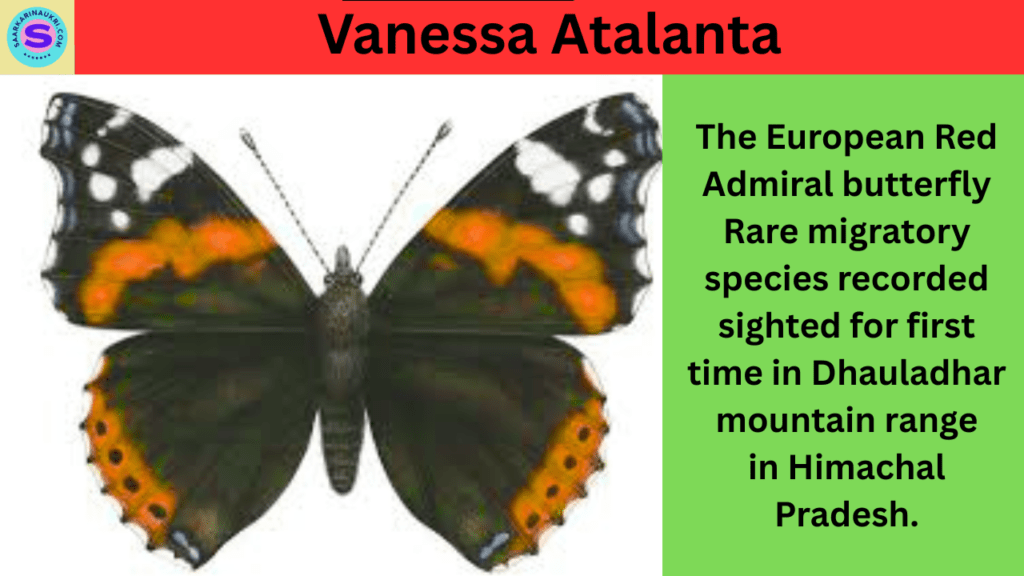
As per the official site of Butterfly Conservation the Red Admiral is a large and strong-flying butterfly which is commonly found in the gardens. The Red Admiral butterfly is most commonly familiar and distinctive insect which can be found anywhere in the Britain and Ireland and in all types of habitat.
Starting from spring to summer the northward migrations of the Red Admiral butterfly starts and it is variable in extent and timing from North Africa and continental Europe. The immigrant females of the Red Admiral butterfly lay their eggs in the spring season and consequently there is an emergence of fresh butterflies come out from July onwards. The Red Admiral butterfi;y continue flying into October or November. There is an indication that numbers of the Red Admiral butterfly have been increased in recent years and that overwintering has occurred in India also.
The Red Admiral butterfly (Vanessa atalanta) has been sighted for the first time in India’s Dhauladhar mountain range in Himachal Pradesh. Some of characteristics of the Red Admiral butterfly (Vanessa atalanta) is given below.
Size and Family –
Family – Nymphalids
Size – Large
Wing Span Range – 67mm – 72mm (male to female)
Morphologically difference –
As per the morphology The Indian Red Admiral butterfly resembles with the European Red Admiral butterfly. The European red Admiral butterfly can be distinguished by its narrower, deeper crimson discal band and the consistent presence of a diagnostic spot in the upper forewing but this feature is absent in the Indian species of the Red admiral butterfly.
The biological name (Binomial name) –
The Indian Red Admiral butterfly -Vanessa indica.
The European Red Admiral butterfly – Vanessa atalanta.
Globally Distribution –
The Red Admiral (Vanessa atalanta) is found in the temperate regions of North Africa, North and Central America, Europe, Asia, and island regions of Hawaii, and the Caribbean.
Habitat –
The Red Admiral butterfly (Vanessa atalanta) is found in a wide variety of habitats, including gardens, open woodlands, and even urban areas with sunshine and suitable host plants. The habitat of Vanessa atalanta can also be found as per the preferences of location –
General Habitats –
Red Admirals are commonly seen in gardens, fields, open woodlands, and even urban areas like town centers.
Specific Locations –
They thrive in areas with plenty of sunshine and are often found near nettles (Urticaceae), which are used as host plants for their caterpillars.
Behavior –
The male butterflies are known to be territorial in order to find a mate. The males will patrol their territorial boundaries up to thirty times an hour. If an intruder enters their area, they attempt to drive them away by out-flying and out-maneuvering the intruding butterfly. The species appears to be most active throughout the spring and fall months. Adult Red Admirals will hibernate throughout the winter months. (source of information – Animal Diversity Web)
Mating and lay their eggs –
The Red Admiral butterflies are the territorial butterflies and the male Red Admiral butterfly patrol their areas in order to find female mates. The males butterfly typically flies in the mid afternoon and wait for females to fly in their area. Once the female Red Admirals butterfly fertilized she will lay their eggs on the upper surface of host plant leaves. (source of information – Animal Diversity Web)
Reproduction –
The majority of Red Admiral butterflies are double-brooded means two generations grow a year. Some of the species of Red Admiral butterflies are single-brooded, means one generation a year, found in the area of the northern parts of Canada and US but in the areas of southern US the some of the species of Red Admiral butterflies are triple-brooded, means three generations a year. (source of information – Animal Diversity Web)
Life cycle of the Red Admiral butterfly –
The general life cycle of the Red Admiral butterfly goes from an egg, to a caterpillar that emerges as an adult. The adult then mates, oviposits, and starts the cycle again. (source of information – Animal Diversity Web)
| Stage | Typical Duration |
| Egg stage | 4 to 14 days |
| Caterpillar (larval) stage | 2 to 4 weeks |
| Chrysalis (pupal) stage | 7 to 14 days |
| Adult butterfly stage | 6 to 20 days |
(source of information – Butterflies at Home)
Feed of their larvae –
The larvae of the Red Admiral butterfly feed on stinging nettle (Botanical name Urtica dioica) which found abundantly in the areas of western Himalayas.
Climate adaptation by Red Admiral butterfly
The species of the butterfly is able to adopt the change in climate due to the diverse of their host plants of the nettle family (Urticaceae). But the species of the butterfly is come on the position to face the challenges from habitat loss and environmental changes affecting plant populations. However, its long-term survival may be threatened by the following reasons –
01) Habitat degradation
02) Urban expansion
03) Declining plant diversity due to environmental changes

Click Here to read the MCQ on the topic.
Click Here read the complete Current Affairs for the Month of May 2025.
Click Here read Current Affairs MCQs for the past month of 2025.
Disclaimer – This information is purely for the educational purpose and there is no intention for Copyright infringement.
Source of the information – The Hindu
All the best for a Brightest future.